Materials
The crystal cabinet
42 entries. Subject list audited against the public Flint & Flicker crystal cabinet. No elixirs. No cures.
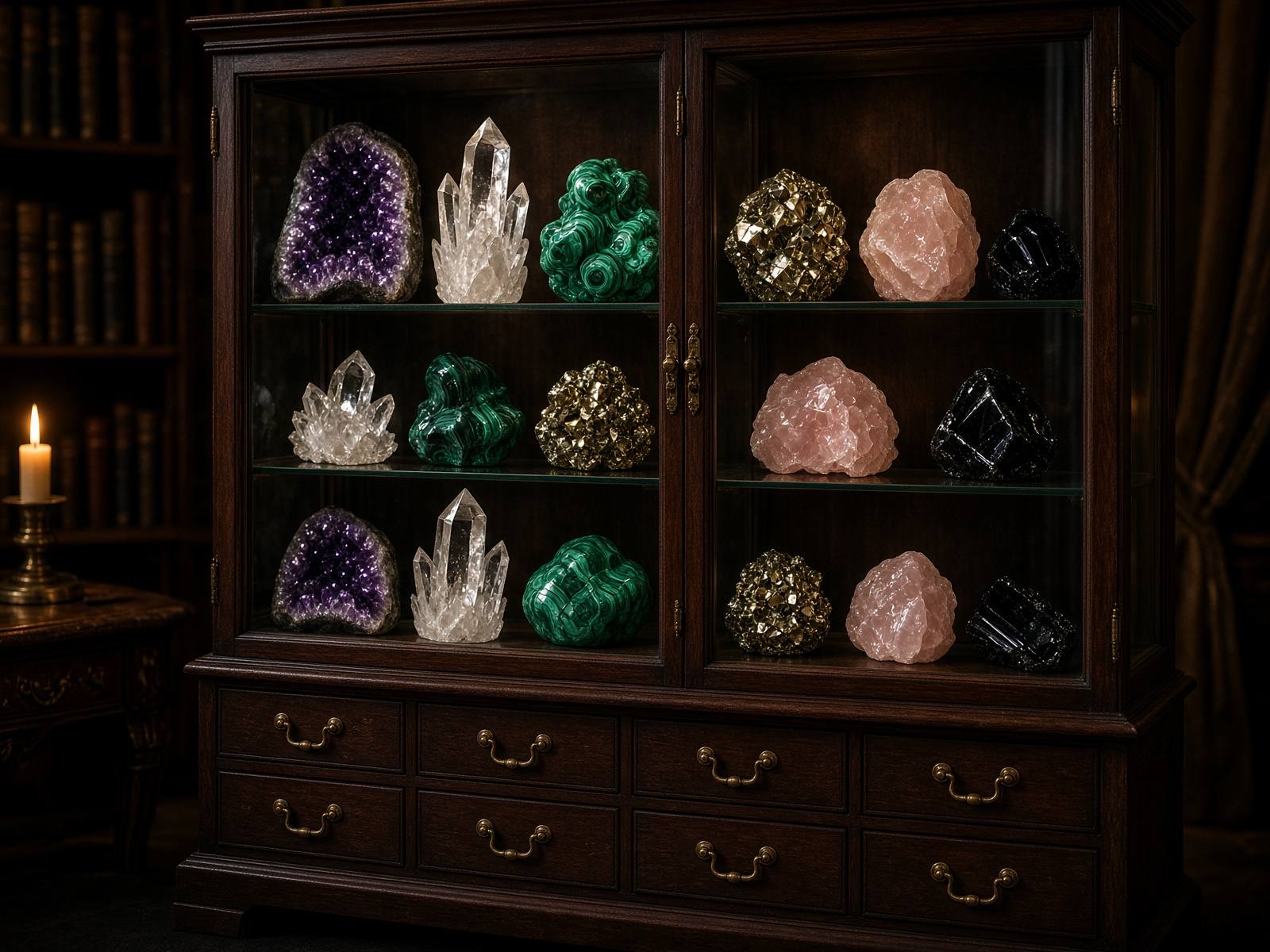
A shop name is not a mineral species. Several entries exist specifically because the trade name is slippery. Symbolic use is a way of paying attention. It is not medicine and it is not a shield that replaces a lock, a friend, or a boundary.
Clear quartz
Quartz, silicon dioxide (SiO2), in its colorless form; sometimes called rock crystal.
MaterialAmethyst
Quartz, silicon dioxide, colored purple by iron and natural irradiation.
MaterialRose quartz
Quartz, silicon dioxide, in a pink massive or, more rarely, crystalline form.
MaterialMoonstone
A feldspar, usually orthoclase or a sodium-rich plagioclase, showing adularescence.
MaterialCitrine
Quartz, silicon dioxide, ranging from pale yellow to brownish orange; natural citrine is colored by trace iron, while much market citrine is heat-treated amethyst.
MaterialBlack tourmaline
Schorl, the black, iron-rich species of the tourmaline group, a complex boron silicate.
MaterialCarnelian
Chalcedony, a microcrystalline quartz, colored orange to red-brown by iron oxide.
MaterialSmoky quartz
Quartz, silicon dioxide, colored brown to black by aluminum in the crystal and natural or artificial irradiation.
MaterialSelenite
Gypsum, hydrous calcium sulfate (CaSO4·2H2O). True selenite is the clear crystalline variety; most wands sold as selenite are satin spar, a fibrous gypsum.
MaterialLabradorite
A plagioclase feldspar, a sodium-calcium aluminum silicate, known for labradorescence.
MaterialLapis lazuli
A rock, not a single species: mainly lazurite (a sulfur-bearing feldspathoid), with calcite, pyrite, and often sodalite or other minerals.
MaterialMalachite
Malachite, a copper carbonate hydroxide.
MaterialTiger's eye
Quartz, a chatoyant pseudomorph in which silica has replaced fibrous crocidolite (a riebeckite asbestos), leaving the silky band.
MaterialObsidian
A volcanic glass, not a mineral species: usually rhyolitic lava that cooled too fast to crystallize.
MaterialMoss agate
Chalcedony, microcrystalline quartz, with dendritic inclusions of manganese and iron oxides.
MaterialFluorite
Fluorite, calcium fluoride (CaF2).
MaterialGreen aventurine
A quartzite, made of quartz grains, sparkling with included fuchsite mica.
MaterialPyrite
Pyrite, iron sulfide (FeS2), often called fool's gold.
MaterialHematite
Hematite, iron oxide (Fe2O3).
MaterialSodalite
Sodalite, a sodium aluminum silicate chloride, a feldspathoid.
MaterialAmazonite
A green variety of microcline feldspar, sometimes intergrown with albite.
MaterialRhodonite
Rhodonite, a manganese silicate, often cut with its black manganese-oxide veins.
MaterialRhodochrosite
Rhodochrosite, manganese carbonate (MnCO3).
MaterialGarnet
A group of nesosilicate minerals, not one species. Common red jewelry is often almandine or pyrope; grossular, spessartine, andradite, and uvarovite are other garnets.
MaterialBloodstone
Dark green chalcedony with red spots of iron oxide, also called heliotrope.
MaterialSunstone
A feldspar, often oligoclase or labradorite, glittering with oriented platelets of hematite or copper.
MaterialGolden healer quartz
Quartz, silicon dioxide, with iron staining or iron-oxide inclusions. Golden healer is a trade name, not a species.
MaterialBlue lace agate
Chalcedony, microcrystalline quartz, in a pale blue banded variety. Blue lace agate is a trade name for that look, not a separate species.
MaterialChrysocolla
Chrysocolla, a hydrated copper silicate, often mixed with quartz, malachite, or other copper minerals. Gem silica is the harder, quartz-rich form.
MaterialKyanite
Kyanite, an aluminum silicate (Al2SiO5), the blue-bladed polymorph of andalusite and sillimanite.
MaterialCelestite
Celestine (also called celestite), strontium sulfate (SrSO4).
MaterialAngelite
Not a species. A trade name, usually for blue anhydrite (calcium sulfate, CaSO4) or a related gypsum-group material.
MaterialLarimar
Pectolite, a sodium calcium silicate hydroxide, in its blue massive variety from the Dominican Republic.
MaterialTurquoise
Turquoise, a hydrated copper aluminum phosphate.
MaterialJade
Two different minerals share the everyday word: nephrite, an amphibole (tremolite to actinolite), and jadeite, a pyroxene. Much that is sold as jade is neither.
MaterialJet
Not a crystal and not a mineral. Jet is a gem-quality lignite, a form of fossil wood and coal.
MaterialOnyx
True onyx is parallel-banded chalcedony, a microcrystalline quartz, classically black and white. Shop onyx is often dyed agate. Mexican onyx is usually banded calcite, a different mineral.
MaterialHowlite
Howlite, a calcium borosilicate hydroxide, naturally white to gray.
MaterialAmber
Not a mineral and not a crystal. Amber is fossilized tree resin. Copal is younger, less polymerized resin and is often sold as if it were amber.
MaterialOpal
Opal, hydrated silica, a mineraloid rather than a crystalline mineral. Precious opal shows play-of-color; common opal does not.
MaterialPeridot
Olivine, specifically a magnesium-iron silicate in the forsterite to fayalite series, gem-quality pieces being toward the magnesium-rich, iron-bearing forsterite end.
MaterialSnowflake obsidian
Volcanic glass, the same material as obsidian, with white cristobalite inclusions that look like snowflakes.