A 1970s name for an older sky
Mabon
Mabon, as a name for the autumn equinox, was given by Aidan Kelly in the 1970s. Mabon ap Modron is a Welsh mythic figure and was not historically the equinox god. Keep the equinox. Do not conscript the myth.
Where the feast comes from
The autumn equinox is an astronomical event: day and night nearly equal, and afterward the nights lengthen in that hemisphere. People have marked equinoxes, harvests, and storage seasons in many ways for a very long time. The name Mabon for this sabbat is not one of those ancient names. Aidan Kelly, an American Wiccan writer, assigned it in the 1970s while building a liturgical calendar. The name spread through the late-century pagan books until many readers met it as if it had always been there. It had not. If you use it, you are using a modern Wiccan calendar word. That can be a fine word if it is honest.
Mabon ap Modron is someone else. In Welsh tradition he is a divine youth, son of Modron, the mother-figure whose name is kin to Matrona. He appears in Culhwch and Olwen as a prisoner taken from his mother in infancy, found with the help of the oldest animals, and rescued so Arthur's impossible tasks can continue. The name Maponos, 'divine son,' is attested earlier in Roman Britain and Gaul. None of that dossier makes him the god of the autumn equinox. Attaching him to the balance of day and night was a twentieth-century poetic decision, and not every poetic decision should be taught as mythic fact. You can read the Welsh stories on their own terms. You can celebrate the equinox without calling him down as a seasonal functionary. The Wilde Altar prefers the second, or the first done carefully, and refuses the blur.
How it is kept now
Modern pagan practice at this date leans on thanksgiving, the second harvest, storage, and the idea of balance. Use what is useful. Thanks can be specific. Storage is holy in the practical sense: you label the freezer, you mend the coat before the cold, you pay the bill that keeps the lights on, you pick what your climate is actually yielding. Balance, as a sermon, goes bad quickly. Lives are not symmetrical. A person in grief, debt, or pain is not failing the equinox. The sky's near-equality is not a report card. You may notice what is too heavy and set one part of it down. You may also admit that nothing can be set down today. Both are accurate rites.
Do not build the day around a kidnapped boy-god whose story you use as seasoning. If you tell Mabon's tale, tell it as a Welsh story, entire enough to be strange, and not as an allegory you invented for falling leaves. Falling leaves are already intelligible. Children can hear that day and night are about the same length and that we store food. They do not need a sacred kidnapping to make the soup meaningful.
North, south, and the weather you actually have
In the north, the September equinox is a plausible autumn door: school terms, late tomatoes, earlier evenings, the last of some markets. In other northern places September is still fully summer, and the coat stays in the closet. Trust the evening temperature over the sabbat's color palette. You do not need fake leaves, and you do not need to perform a chill you cannot feel. If the harvest where you are is fish, squash, or a second planting, let that be the thanksgiving instead of a generic apple.
In the south, the autumn equinox falls around March, often near the start of a school year or a cooling, and sometimes near harvests that a northern book thinks happen in September. If you swap the wheel, this is your Mabon-as-equinox, under whatever name you choose. You might choose to call it the autumn equinox and leave the name Mabon in the history lesson. That is a good choice. If you keep the September date for community, you are likely keeping spring, so decorate for spring or you will be lying to the garden. In the tropics, an equinox is a real sky event with little seasonal drama. Store what your wet or dry season asks you to store: water, batteries, rice, shade cloth. The British pantry is not the universal pantry.
An altar that can be put away
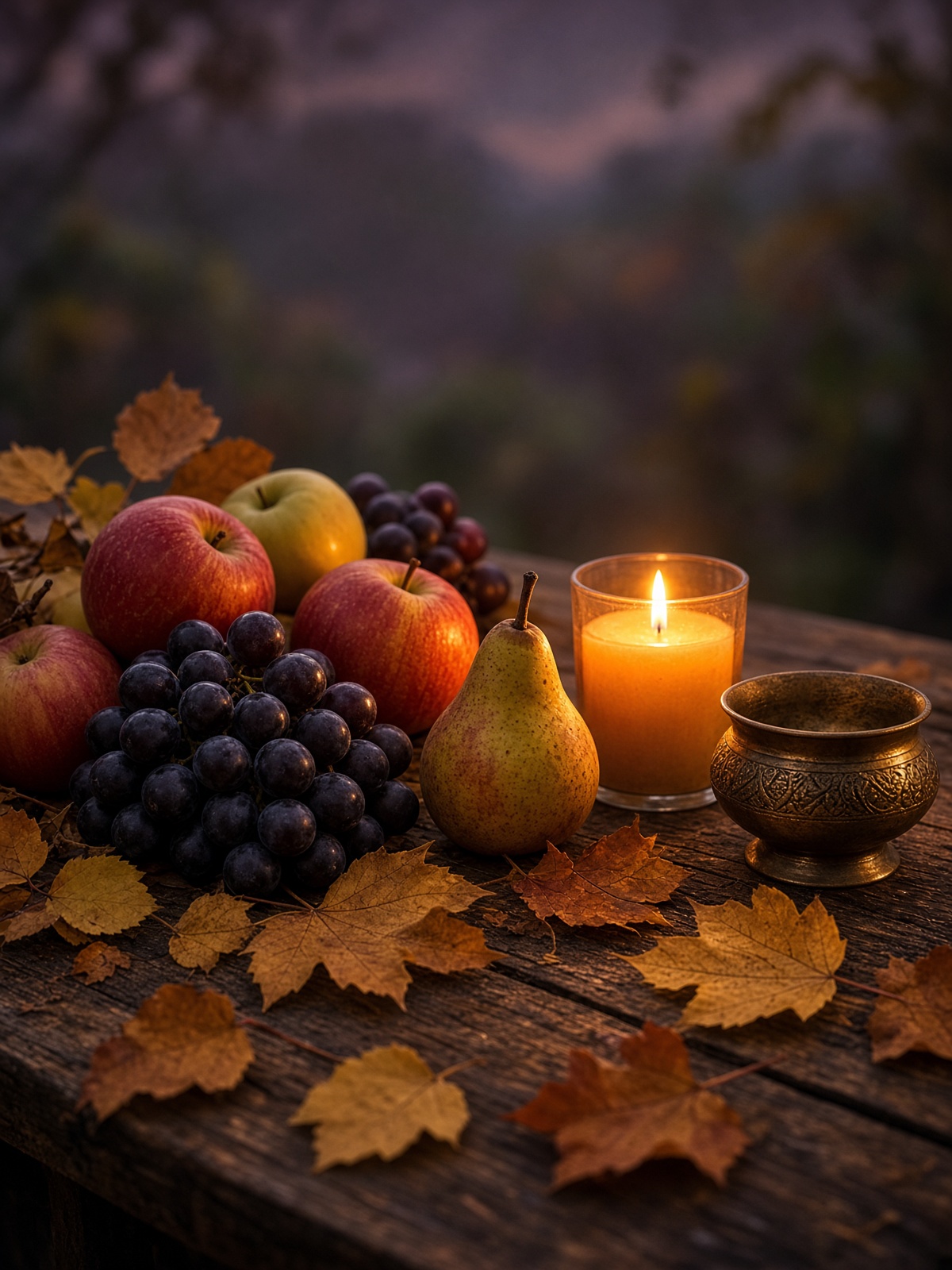
Two bowls or two cups: one holding something you are keeping, one holding a slip of paper for something you are done carrying. A local fruit, a candle or lamp, a coat you mended. No skulls required, no kidnapped-child imagery, no purchased 'equinox god' statue. The fruit should be eaten. The paper should be a real relinquishing, not a wish that someone else disappear. If what you want to put in the release bowl is a person, stop and reread the pruning essay. We do not compost people.
Autumn-colored cloth is optional and often ridiculous in a hot climate or a southern March that is only just cooling. Use the color of your actual fruit, or no cloth at all. Clear the altar when the fruit is gone. Balance that cannot be put away is not balance; it is a shelf of clutter with a theological excuse. Return the cups to the cupboard the same night so tomorrow's breakfast does not have to negotiate with a metaphor.
Solitary, and with chosen family
Alone, eat the fruit, write the thanks, and do one storage task: the freezer, the folder, the coat, the password written somewhere safe for the person who would need it. Solitary equinox is a good accountant of a life. It does not require an audience or a partner. If the near-dark of the coming half frightens you, plan one light for it now, a literal lamp or a friend. Planning is ritual.
With chosen family, make the meal and let each person say one thanks and one thing they are storing for someone else: a skill shared, a spare key, a pot of soup, childcare, a ride. The feast is civic in the small sense. No one has to pair off. No one has to embody a god. If you tell stories, tell true ones about the land you are in, or tell the Welsh tale as a tale with its name and its book, not as the origin of your equinox. Chosen family is often the real harvest of a year. Say so without turning people into symbols.
The table, including if you do not cook
The apple-oat pan is a small skillet dessert or breakfast, apple and oats and a little fat. It is food, not medicine and not a spell. If you do not cook, bread and butter and an apple you simply bite are a complete equinox supper. Wash the apple. Sit down. The year is turning whether or not you caramelized anything.
If apples are out of season or expensive, use a pear, a plantain you know how to cook until soft, or the bread alone. Do not forage mushrooms to feel autumnal. Do not serve hard cider as a requirement, and do not turn the drink into the point of the rite. Children and people who do not drink alcohol are full members of the harvest. A sliced apple on buttered bread, eaten at the table, has as much equinox in it as a styled supper, and it asks less of anyone who is tired.
Correspondences, labeled as such
| Northern seasonal date | The September equinox, around 22 September. The name Mabon for this date is modern. |
| Southern seasonal date | The March equinox, if you are marking local autumn. Consider calling it the autumn equinox rather than importing the 1970s name unexamined. |
| Historical core | An astronomical equinox plus many harvest customs worldwide. The sabbat-name Mabon: Aidan Kelly, 1970s. The figure Mabon ap Modron: Welsh myth, not the equinox god. |
| Modern theme | Specific thanks, storage, one thing set down. Not a symmetry contest. |
| Table | Bread and butter, with or without an apple, is enough if you do not cook. |
An original rite
Materials. Two cups or two small plates, everyday ones · Something to keep: bread, a key, a mended button, a written plan for the cold or the rain · A slip of paper and a pen for one burden you can truly set down, or the words 'nothing today' if that is the truth · An apple, the oat pan below, or bread and butter · A lamp or candle, and a cup of potable water
- 1Set the two cups where you can see them. In one, place the thing you are keeping. In the other, place the paper. Do not put a person's name in the release cup.
- 2Say the date and the hemisphere's fact: nights will lengthen, or day and night are nearly equal and the change is slight, whichever is true where you stand. Speak the words of the rite. Do not invoke Mabon as equinox god. You may say nothing divine at all.
- 3Read one specific thanks: a person, a field, a wage, a tree, your own persistence. Eat some of the food before you continue. Hungry theology is dramatic and unkind.
- 4Read what you are setting down. If it is a task, write the day you will end it. If it is a story you rehearse, write the sentence you will use when it starts up tonight. If you wrote 'nothing today,' honor that.
- 5Do one storage act now, small: label a container, move the coat to where the cold will find it, put the flashlight where the dark will find it, file the paper the future you needs.
- 6Drink the water. Tear the release paper and recycle it, or keep it in a book if you still need the reminder. Do not burn it in an unsafe room.
- 7Clear the cups. The scale does not stay on the table as a permanent judgment. Wash them. They go back to being cups.
Day and night are nearly a match, and my life is not a scale. I thank what fed me. I store what will keep. I do not make a Welsh youth into a calendar decoration.
Close. Put out the flame if you lit one. Say the equinox has been noticed and the kitchen is released from symbolism. Eat the rest of the apple or put it in the fridge.
A practical action. Finish the storage act if you only started it. In the coming week, go to bed a little closer to the dark you actually have, or fan the room if what is increasing is heat. Follow your hemisphere, not a sticker set of leaves.
A table
- 1 apple, sliced, or 1 pear, or 1 cup of another fruit you know how to cook until soft
- 1 teaspoon butter or oil
- 1 teaspoon honey or sugar, or skip it
- A pinch of salt
- 2 tablespoons rolled oats
- 2 tablespoons water
Method
- 1Melt the butter or oil in a small pan. Add the apple and the salt.
- 2Cook on medium until the apple softens, about 6 to 8 minutes, stirring so it does not scorch.
- 3Add the honey or sugar if you are using it, then the oats and the water. Stir until the oats are soft and the water is absorbed, 2 or 3 minutes more.
- 4Eat from a bowl. If you do not cook, bread and butter and a washed apple you eat raw are a complete equinox supper. Refrigerate leftovers and finish them within a day.
Questions
- When you say Mabon, do you mean a 1970s sabbat name, a figure from Welsh story, or a blur you could now undo?
- What are you storing that will matter in six weeks, in your actual climate?
- What burden are you calling balance that is simply too much?
Sources and further reading
- Encyclopaedia Britannica, Maponos. Mabon son of Modron is a Welsh and older British divine youth, not a documented god of the autumn equinox.
- Encyclopaedia Britannica, modern Paganism, where Mabon names the autumn-equinox sabbat of the contemporary Wiccan wheel. The naming is modern even when the sky is not.
- The Metropolitan Museum of Art. Harvest and autumn images vary by climate and culture; use them to widen the feast beyond one Welsh name and one New England leaf.