Midwinter, intertwined with Christmas and not the same
Yule
Yule is a Germanic midwinter feast. Christmas is the Christian feast of the Nativity, set near the solstice and braided with northern custom for a thousand years. Keep both histories, and keep the night small enough to survive.
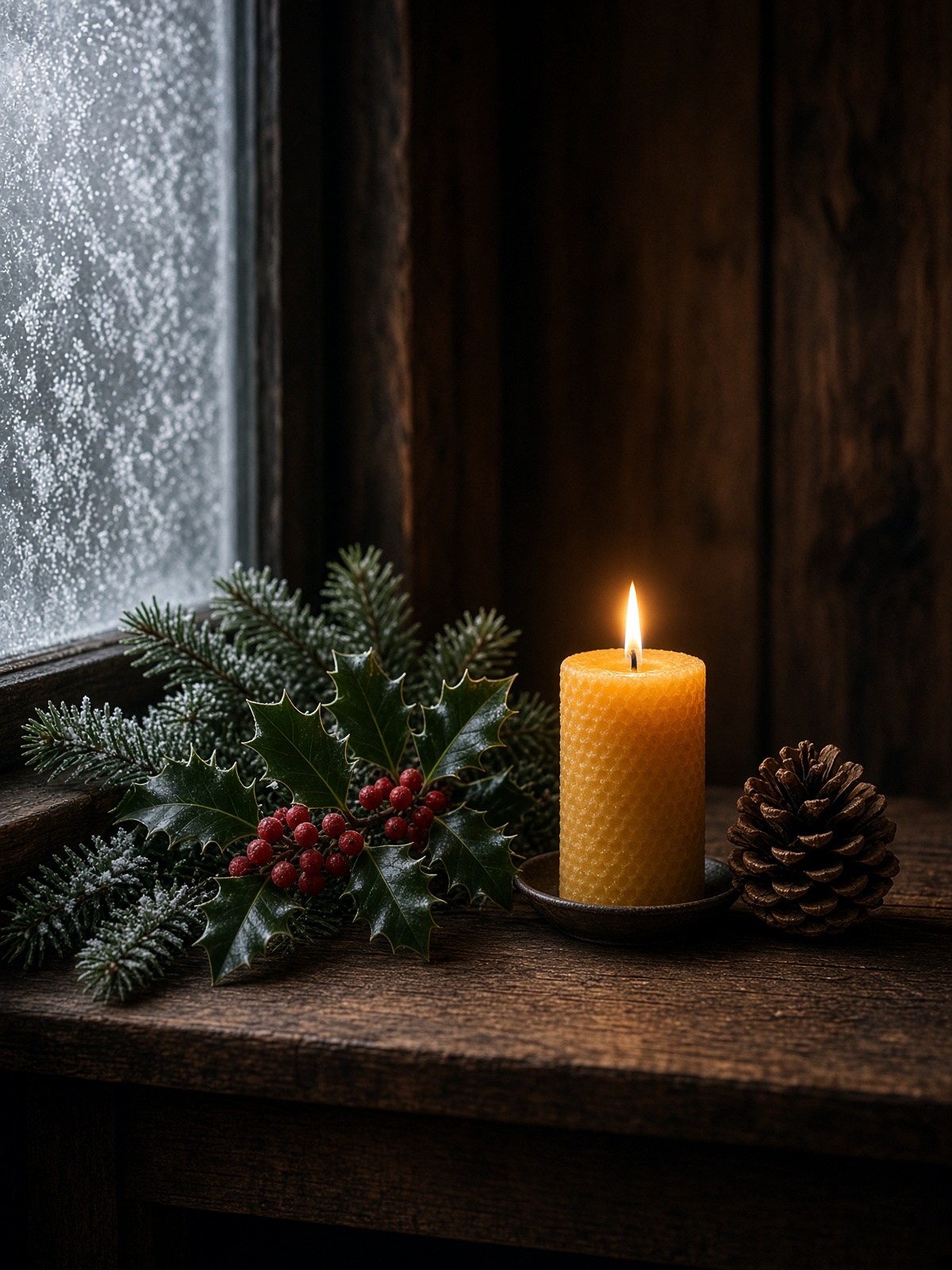
Where the feast comes from
Yule, Old Norse jól and its kin, Old English gēol, is a midwinter feast known from medieval Germanic sources. In Scandinavia it was a long drinking and feasting season with legal and social weight, later pulled onto the Christmas dates as kingdoms converted. Bede, in the early eighth century, writes about giuli as a midwinter span in the old calendar of the English. That is a real thread. It is not a minute-by-minute pagan liturgy you can reconstruct from a shop of red ornaments. In many northern languages a word like Jul still simply means Christmas. The two feasts have been intertwined since the conversion centuries. They are not identical. One is not a pure original and the other a theft in a simple slogan. People lived inside both, often at once.
The winter solstice is astronomy: the longest night in a given hemisphere, the Sun's noonday height at its lowest, and then the slow return of day length. Many cultures have marked that fact in ways that are not Germanic Yule. When modern Wicca puts Yule on the solstice as a sabbat of the returning sun, it is using a twentieth-century wheel, the same Gardner-and-after synthesis that frames the other seven. The battle of the Oak King and the Holly King, sometimes described as Celtic legend, is a modern literary motif, popular in twentieth-century pagan writing. Do not teach it as ancient Celtic history. Evergreen boughs, a Yule log, a boar, gifts: some are early, some are early modern, some are Victorian, some are advertisements. You may love a fir branch without issuing it a false passport. You may celebrate Christmas as Christmas, Yule as Yule, both in one household with honest labels, or neither.
How it is kept now
A contemporary Yule can be very plain: a light left on a little longer, a meal that is warmer than last week's, a promise to check on someone in January when the cheer industry has left. The theological claim available to pagans, that the light returns, is a description of day length in temperate latitudes and a metaphor if you want it. It is not a guarantee that your depression lifts on December twenty-second. If the dark season makes you ill, the rite includes whatever actually helps, on a doctor's advice, and a smaller symbolism. Do not quit medicine for a sun wheel.
Because Christmas is the public holiday in many countries, Yule practitioners are often guests in someone else's holy day. Go as a guest if you go: eat what was offered in good faith unless it harms you, skip the theological argument at the table, keep your own short rite at home if you need the solstice named. If you host, do not trap a Christian relative inside a circle. A shared meal with the religious words said privately, or said in turn with consent, is peace. Gift-giving, if you do it, should be inside your means. A letter costs less than a debt. The longest night does not require a store.
North, south, and the weather you actually have
In the north, Yule belongs to the December solstice, near Christmas on the civic calendar, which is why the braiding is so tight. Long nights are real. Cold may or may not be, depending on your coast or your warming year. Decorate for the night you have. If there is no snow, do not buy snow. Candlelight and a pot of something hot tell the truth.
In the south, the December solstice is midsummer. Calling a barbecue in full sun 'Yule' because a British calendar said December will make the religion sound like a costume. Many southern practitioners move Yule to the June solstice, when the night is actually long, and keep December as Litha if they use that name. Others mark both a cultural Jul with family at Christmas time and a seasonal midwinter rite in June. Both are choices. Say which one you are doing. In the tropics the solstice is a subtle shift in the sun's path, not a long Gothic night. You may mark the astronomical moment with a short acknowledgment and put the feast on the weather that actually changes your life: the dry, the rains, the cyclone season. No one is more pagan for owning a wool cloak.
An altar that can be put away
One candle or a lamp, a bit of evergreen only if you can get it without cutting what is protected or annoying a landlord, or a picture of the sun if greenery is wrong for your season. A bowl of oranges is more honest in many kitchens than a log. If you burn a wood fire, burn it in a safe hearth and not in an apartment sink. The Yule log as a household custom is beloved and later than the medieval feast; a printed log-cake is a joke you may eat without believing it is Viking. Put away what is flammable before sleep. Cats and evergreen needles and open flames are a known story. Write the story out of your night by using a lamp.
If the altar is shared with Christmas, let the nativity stay the nativity and the solstice candle stay labeled in your own mind. Mixed houses do not need a winner. A child can be told, in one sentence, that different people see different hopes in the same dark, and that the hope in this house includes them getting enough sleep. That is theology enough.
Solitary, and with chosen family
Alone, the longest night can be tender or heavy. Plan the ordinary safety: a meal you like, a way to sleep, one person you could call if the quiet turns bleak. You may watch the dusk and the dawn if your latitude and your body allow, or you may sleep through the middle like a sensible animal. Sleeping through the solstice is not a ritual failure. It is winter.
With chosen family, agree on the size. A potluck where everyone knows the dietary truth of the group beats a spectacle. Phones down for ten minutes is a stronger shared rite than a speech. If someone is spending the civic holiday with blood family and the solstice with you, do not make them compare the two loyalties out loud. Romance is optional. Midwinter is not a couple's holiday unless you decide it is. A house of friends under a blanket watching the street get dark is a complete Yule.
The table, including if you do not cook
The barley cup below is a one-pot warmth. Rice works if barley is not in the shop. It is food, not a solar sacrament and not medicine. If you do not cook, bread and butter beside a hot drink you already know how to make is a full midwinter plate. Buy the bread. The night is long enough without a baking project.
If you are a guest at someone else's Christmas table, you do not also need to cook a pagan menu in secret. Eat, help wash up, go home, light your own lamp for five minutes. Hospitality counts on both sides. Do not serve alcohol as if it were required; plenty of historical Yule was drinking, and plenty of living people do not drink. Juice, tea, and water are complete.
Correspondences, labeled as such
| Northern seasonal date | The December solstice, around 21 December. Civic Yule and Christmas sit near it for historical reasons. |
| Southern seasonal date | The June solstice, if you keep Yule as local midwinter. December can remain a family Christmas or a midsummer rite instead. |
| Historical core | Germanic midwinter feast, later intertwined with Christmas. Not identical to it. Not a reconstructed minute-by-minute rite. |
| Modern theme | Longest night, a careful light, a warm plate, the slow return of day length where that is true. |
| Table | Bread and butter is enough if you do not cook. |
An original rite
Materials. A candle or tea light in a holder, or a lamp if you cannot have flame. The lamp is a complete wick · A safe surface such as a ceramic plate or a bare metal tray, away from curtains, pets, and anywhere you might fall asleep · A warm portion of food, the barley cup below, or bread and butter · A cup of something hot you can drink: tea, cocoa, broth, or plain hot water · A clock or the timer on a phone, and a coat or a blanket if you step outside and the step is safe
- 1Before dusk, or before your household's quiet hour, set the light and the food. Eat something before any long watching. Hunger makes the dark theatrical.
- 2When the evening has truly settled, light the wick or turn the lamp on. Speak the words of the rite. If you are in the tropics or in summer because you kept a northern date, change the words' night to the fact you have: a turning, not a costume of snow.
- 3Sit with the light for a short, set time: ten minutes, or the length of the cup. You may name one thing that was hard in the dark of the year and one thing that held. Do not demand that the hard thing become a lesson.
- 4If a walk is safe, step out and look at other people's windows. Come back. If it is not safe, look at your own lamp. Other lights existing is the fellowship.
- 5Eat the warm food if you have not already. Do not leave a candle burning while you drift off.
- 6Extinguish the flame yourself, or set the lamp to its night setting. Say that the sun, or simply the next morning, does not need you to stay awake in order to arrive.
- 7Prepare sleep: medication if it is prescribed, a glass of water, the alarm you actually need. Midwinter rites that wreck the next day's work are bad rites.
This is the long night, or the night I have. I keep a small light and I will put it out. I do not ask the dark to improve me. Morning may come slowly. I will meet it fed.
Close. Make sure the flame is out and the pan is cool enough. Say the wick is finished and the room may sleep. Leave a night-light if that is what safety requires. Safety is part of the solstice.
A practical action. In the next week, while the civic holiday noise continues or collapses, check on one person and on your own supplies for January, or for the wet season, whichever is coming. A stocked cupboard is a solar return.
A table
- 1/3 cup pearl barley, or short-grain rice if barley is unavailable
- 1 cup water, plus more as it cooks
- A pinch of salt
- 1 teaspoon butter or oil
- 1 teaspoon honey, or a small handful of raisins
- A few thin slices of washed apple or pear, or skip the fruit
Method
- 1Rinse the barley or rice. Put it in a small pot with the water and the salt.
- 2Bring it to a boil, then simmer until tender: about 25 to 35 minutes for pearl barley, or about 15 to 20 for rice. Add water if it goes dry. It should be soft, not chalky.
- 3Stir in the butter or oil, the honey or raisins, and the fruit. Cook 2 minutes more.
- 4Eat from a cup or a bowl while it is warm. If you do not cook, bread and butter and a hot drink are the same feast. Cool the pot before you sleep.
Questions
- Are you marking Germanic Yule, Christmas, the solstice, or some honest combination, and have you said which?
- Does the longest night actually fall in this month where you live?
- What light can you keep without debt, fire risk, or a performance for people who did not ask?
Sources and further reading
- Encyclopaedia Britannica, Yule. Use it for the Germanic winter feast and its modern pagan keeping, and be cautious of any motif, such as a Holly King and Oak King duel, presented as if it were ancient Celtic fact.
- Project Gutenberg, Bede's Ecclesiastical History of England. Bede is the early English witness behind a great deal of calendar talk. His note on giuli and the separate, thin note on Eostre live in his calendar writing; do not treat one popular edition as the whole of him.
- Encyclopaedia Britannica, modern Paganism, for Yule as one sabbat of a modern eightfold wheel, and for the southern shift of dates.