A fire at the start of summer, not a mandate
Beltane
Beltane is the Irish and Scottish May quarter day, a pastoral and protective fire feast. It is not a heterosexual fertility assignment. Desire, creativity, labor, friendship, and the land are enough.
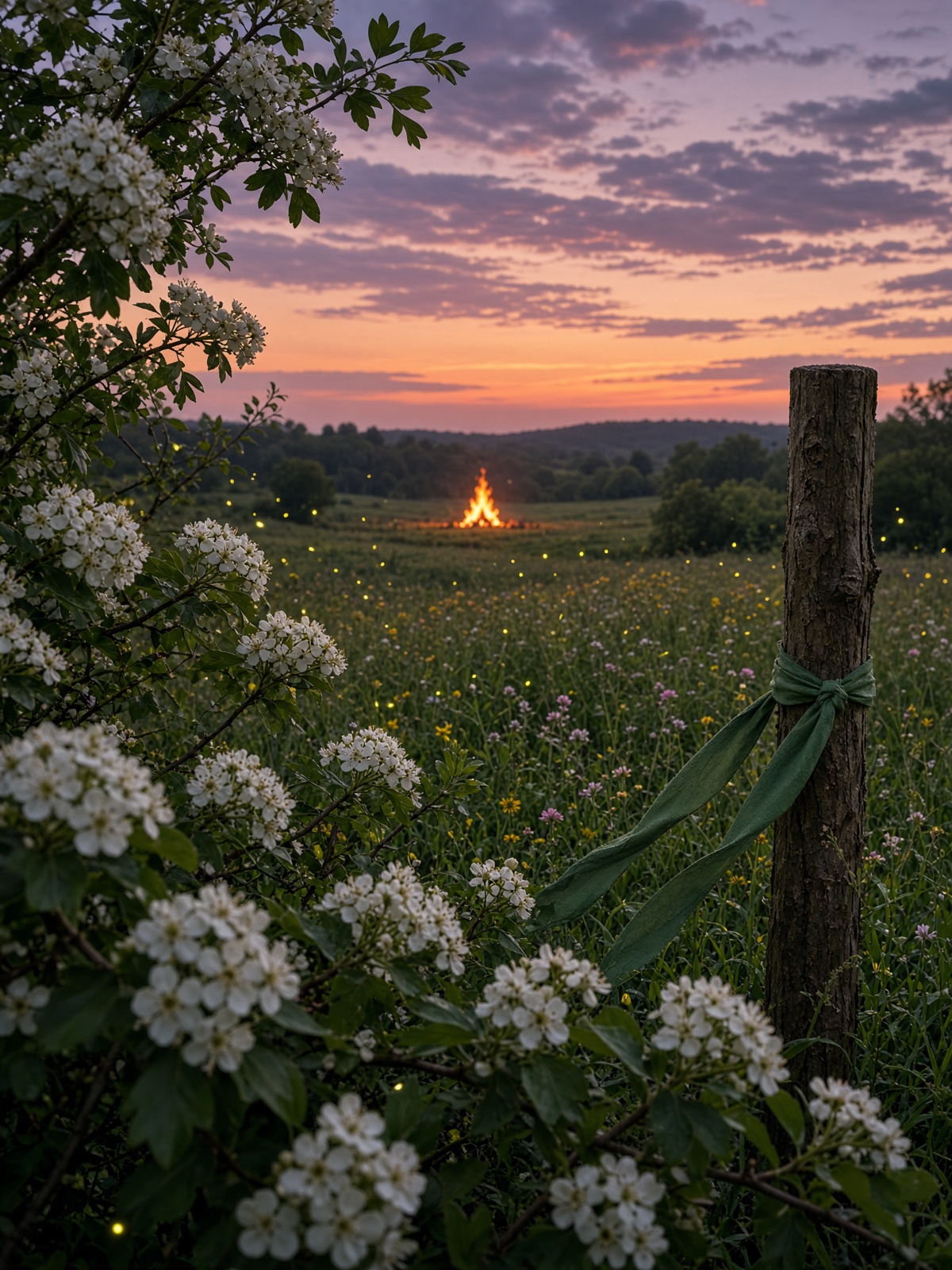
Where the feast comes from
Bealtaine, around the first of May, is the Irish quarter day that opens the summer half of the year, opposite Samhain. A glossary attributed to Cormac of Cashel describes cattle driven between fires as a protection before the summer pasture. Early modern accounts from Scotland and Ireland remember communal fires, household protections, and a sense that the eve was a thin one. The etymology Cormac offers, a god Bel plus the word for fire, is a medieval explanation later scholars have often doubted. You can say 'bright fire' as a possibility and refuse to invent a whole god from one gloss. What the sources support is a seasonal pastoral feast with fire used as protection of the herd and the household, not a script for human sexual initiation.
English May Day is a neighbor, not a twin: maypoles, flowers, May games, later Victorian revival, a long argument with authorities. It shares a date and a joy and should not be collapsed into 'the Celtic sex festival.' Modern Wicca put Beltane on the wheel as a sabbat of sacred marriage and fertility current. That is a twentieth-century theological choice, part of the Gardner and Sanders era synthesis and the books that followed. You may decline it. The older fire does not require a heterosexual couple to stand in for a god and a goddess. It does not require anyone to be sexually available. People who are solitary, queer, asexual, partnered, grieving, or simply private can keep a May fire without playing a role. If a group tells you the rite is incomplete without your body, leave the group. Cattle-between-fires was about cattle.
How it is kept now
A current Beltane can be flowers you grew or bought, a candle at a doorway, a shared breakfast, a dance if you like dancing, a promise to begin the bright-season work: the extra job in the garden, the art you parked in winter, the friendship you feed. Protective customs, historically, were about disease and the herd. Translated with care, that is public health and practical care of what depends on you, not a charm against your neighbor. Wash your hands. Vaccinate on a medical schedule, not a lunar one. The fire does not replace either.
Real fire needs real rules. A bonfire requires land, a permit where the law wants one, water to put it out, and a plan for wind. Most people should use a candle or a grill they already know how to run. Do not jump a fire in a costume that can catch. Do not pressure anyone else to jump. May dew, flower crowns, and all-night woods are optional and sometimes a bad idea in a city or a nesting season. Do not strip protected woodland for a wreath. Desire, if you and another adult both want a private rite, stays private and is not the public teaching. Creativity, labor, friendship, and the land are the public teaching. They are enough.
North, south, and the weather you actually have
In the north, the first of May is a plausible start of the bright half: hawthorn in some lanes, last frost in some valleys, already summer in others. Trust the frost date you actually have before you plant because a sabbat said so. A May morning in one city is a coat. In another it is a burn. Dress for the street.
In the south, the first of May is late autumn, nearer a Samhain logic if you follow weather. The seasonal Beltane, opening of the bright half, falls around the end of October and the first of November, which will feel upside down only if you still think north is the default. Swapping is a respectable choice. Keeping May because your tradition meets then, while letting the flowers be spring flowers of your own September or November, is also respectable. In the tropics, May may be the start of rains or of heat. Let the 'bright half' mean whatever abundance or hardship is actually beginning, and do not import hawthorn at great cost to play England. Local blossom, or no blossom, is the rite.
An altar that can be put away
A candle in a holder, a jar of local flowers or a single leafy branch from your own pot, a ribbon on a handle if it will not block the door in an emergency, a bowl of water, bread. Bright cloth if you have it. No altar arrangement should block the exit. No flower should be a rare wild one you dug. If you have livestock or pets, the protective thought is a vet and a fence, not a ribbon on a horn. Put the flowers in water and throw them out before they slime. A May altar that becomes fruit flies has overstayed.
Skip the paired god-and-goddess figurines if they teach the room that a rite needs a straight couple. A single flame is not lonely. If you want images, choose ones that mean labor and joy to you: a tool, a friend's photograph, a plant. Erotic images, if any, belong where everyone who can see them has consented to see them, not on a family table by default.
Solitary, and with chosen family
Alone, light the candle, eat, and name one bright-season work you actually intend. Dance if you want to dance, in the kitchen, with the blinds as you prefer them. Solitary Beltane is not a lack of a partner. It is a complete feast. You may speak of desire as something that belongs to you, including the desire to be left unbothered. That is a May blessing.
With chosen family, build the smallest fire the law allows or share a candle. Each person may name a creative work, a piece of labor, a friend, or a patch of land. No one names someone else's body. No one is assigned a gendered role. If there is a maypole, the point is the braid and the laugh, and anyone may sit it out. Agree on an ending time so introverts can leave without a scene. Children can make flower crowns from garden weeds and paper. They are not cupids and they are not audience for adult flirtation. Keep that line bright. It is the real fire safety.
The table, including if you do not cook
The honey oat bannock is a small pan bread, cooked through, sweet if you want it, plain if you do not. No alcohol goes in it. It is food, not a love spell. If you do not cook, bread and butter with a little honey, or without honey, is a full May plate. Buy flowers or don't. The bannock will not bind anyone to you, and it should not be baked with that hope folded in. Feed people because feeding is kindness.
Strawberries are seasonal in some Mays and not in others. Use them when they are good and local enough to be honest, and use oats when they are not. A feast that requires out-of-season fruit shipped at a sulk is a weaker poem than oats. If the bannock crumbles, eat it with a spoon. If honey is not in the house, salt is a complete seasoning. The May plate is successful when someone is fed, not when it matches a photograph of a meadow.
Correspondences, labeled as such
| Northern cultural date | Eve of 30 April into 1 May. The frost date of your garden may disagree, and the garden is right about planting. |
| Southern seasonal choice | Around 31 October or 1 November if you open the local bright half. Keeping May as a tradition date is a choice if you rename the weather honestly. |
| Historical core | Irish and Scottish May quarter day, pastoral fire and protection. English May Day is a neighbor. Not a sexual mandate. |
| Modern theme | A small safe fire, flowers, creative work, friendship, labor, the land. Desire only where it is mutual and private. |
| Table | Bread and butter is enough if you do not cook. |
An original rite
Materials. A candle or tea light in a steady holder, or a lamp if flame is forbidden. A bonfire only if it is legal, small, and supervised · A door or a window you can stand near without blocking anyone's exit · Flowers from a shop or your own plant, or a ribbon, or nothing decorative at all · A piece of bannock, or bread and butter · A cup of potable water, both to drink and to be the thing that could put out a small flame in an emergency. Know where the real extinguisher or the tap is
- 1Check the room: flame away from hair, sleeves, pets, and curtains. If you cannot make it safe, use the lamp and do not feel reduced.
- 2Stand at the doorway. Speak the words of the rite. Name the season outside as it is, not as a Maypole card imagines it.
- 3Name one work of your hands, one friendship you will feed, and one care for the land or the street you can actually do. Do not name a person you desire unless they are present and have agreed to be named. Better: do not name desire in a group rite at all.
- 4Light the candle or lamp. If others are with you, each may add one name of a work or a friend, or pass. No role is assigned by gender. No one jumps anything.
- 5Eat the bread. Drink the water. Let the flame be short, measured in minutes, not in a dare.
- 6Extinguish the flame with care. If it is a candle, snuff it. If anything caught, the rite is over and the emergency is the emergency.
- 7Take the decoration down if it blocks the door. Put flowers in water or compost them when they fade. The doorway has to work in the night.
A fire can protect without consuming anyone. I do not pledge a body that is not mine to pledge. Work, friend, and land are enough. The bright half begins with a door that still opens.
Close. Make sure the flame is cold. Say the doorway is a doorway again. Wash honey off the plate before the ants hold their own feast.
A practical action. This week, do the land-or-street care you named: the sweeping, the planting at the right frost date, the check-in with a friend, the shift you said you would cover. Leave other people's romantic lives unarranged.
A table
- 1 cup rolled oats, or 3/4 cup flour
- A pinch of salt
- 1 tablespoon butter or oil, plus a little more for the pan
- 1 teaspoon honey, or sugar, or skip it
- 3 to 5 tablespoons milk or water
- A pinch of dried rosemary, or skip the herb and leave the cake plain
Method
- 1Mix the oats or flour, salt, honey, and herb. Cut in the butter. Add milk or water a spoon at a time until the dough holds together and is not dry dust.
- 2Heat a lightly oiled pan over medium-low heat.
- 3Press the dough into one small cake. Cook until the underside is golden and the inside is no longer wet, then turn and cook the other side, about 4 to 6 minutes a side. If it browns before it cooks, lower the heat and cover the pan. Flour cakes must be cooked through, not gummy in the center. Split one to check.
- 4Cool slightly and eat. If you do not cook, bread and butter, with or without honey, is a complete May plate. No alcohol belongs in this recipe.
Questions
- Which Beltane are you keeping: pastoral fire, English May, modern Wiccan fertility current, or a quieter thing of your own?
- Who would be harmed if this feast required a couple, and what will you say instead?
- Is the bright half actually beginning where you live, or is another season knocking?
Sources and further reading
- Encyclopaedia Britannica, Beltane. Cormac's fire custom and the May date are the useful core. Treat god-Bel etymologies and any blending with English maypoles as debated or neighboring, not as one original rite.
- Encyclopaedia Britannica on Celtic festivals, for Beltine as the start of the summer half opposite Samhain.
- Encyclopaedia Britannica, modern Paganism, for Beltane's place on the twentieth-century wheel, including southern-hemisphere date shifts.